

Breadth Without Surface Area: The New Geometry of Product
Why the "cleanest" AI interfaces are often the hardest to use. A deep dive into Product Entropy, the Discovery Gap, and the transition from managing Flow to managing Constraints.


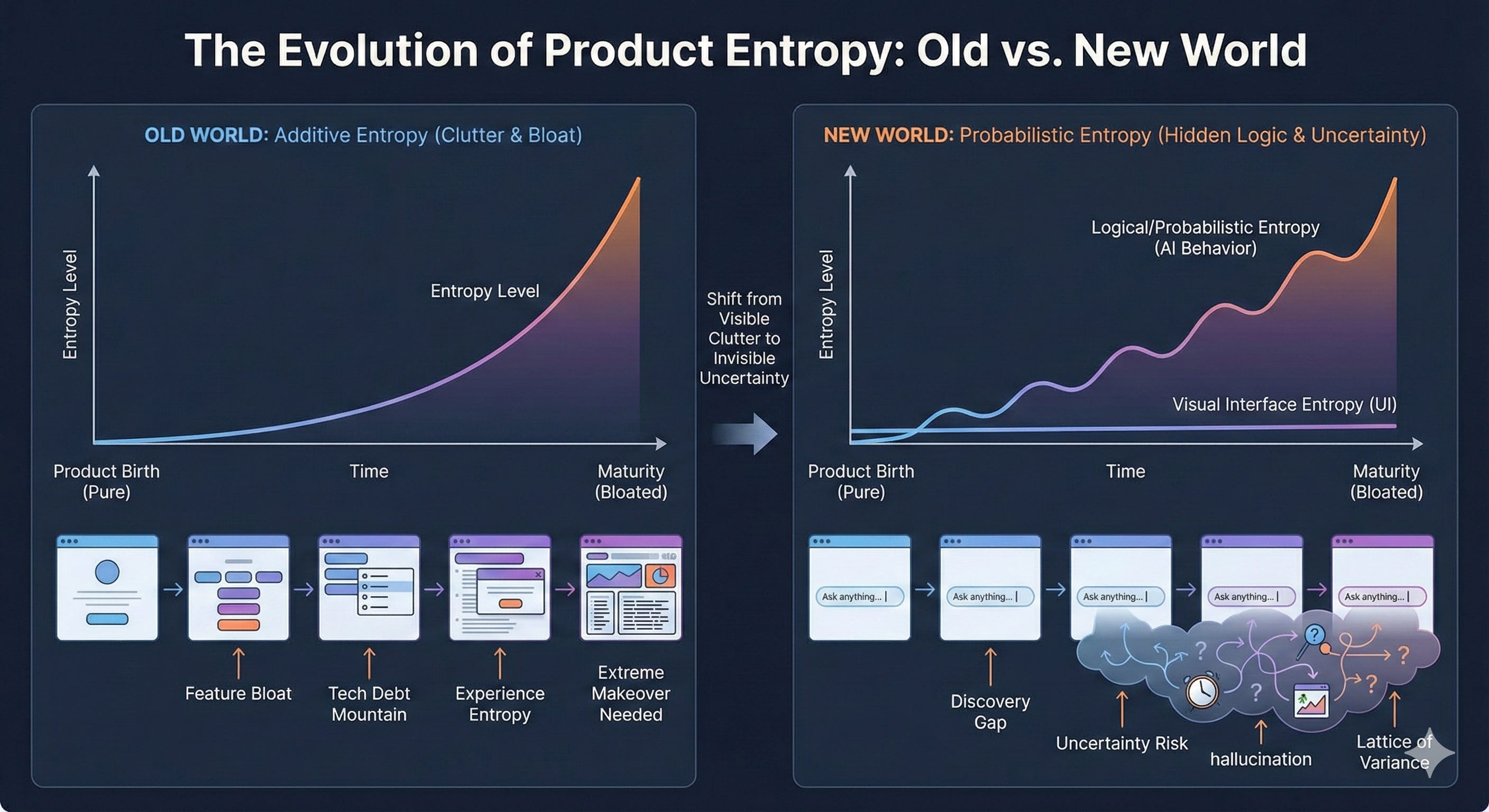
Every product is born pure. But in our universe, purity is unstable. The second a product meets the real world, the laws of physics take over, and Entropy begins its attack
The amount of entropy that exists is exactly what you want it to be. It is exactly what you design for.
As it grows, the entropy increases. It takes intentional effort to manage that entropy. It takes expertise to keep it contained.
AI is introducing new variables of entropy. The existence, type, and effects are largely unknown, or unrealized.
Types of Product Entropy
As that “newborn” product grows, three types of entropy inevitable set in:
Experience Entropy (The Clutter): Every version adds a button, a tab, or a setting. The clean interface you launched with slowly calcifies into a dashboard where users can’t find the “Logout” button.
Feature Entropy (The Constriction): Your first feature solves a user problem. Your tenth feature has to solve a user problem without breaking the previous nine. Your solution space shrinks with every release.
Tech Entropy (The Debt): Agile shifts direction; yesterday’s perfect architecture becomes today’s legacy code. Suboptimal decisions that you had to take to deliver mounts yet another tech debt to the mountain of doom. You aren’t just managing code; you are managing the archaeology of past decisions.
We can try to manage the quantum of these entropies, but they are not totally avoidable.
As Products evolve and mature, the entropy exponentially increases. This is one reason why we see extreme makeovers (of experience, features and tech). It is an attempt for a fresh start with minimal entropy.
In the “Old World,” every new feature was a physical addition to the product’s body (a new button, a new page). This is Additive Entropy. In the “New World,” you don’t add to the body; you add to the Mind. When you teach an Agent a new “skill,” the UI doesn’t change. The “Newborn” stays small, sleek, and pure, but it becomes infinitely more capable.
AI’s effect on Entropy
New technologies new entropy?
Not really. AI changes the fundamental structure of entropy. It alters the equation and its variable.
The Paradox of the Blank Box
When you can ask for something, you do not need to discover it. Native AI approach promises hyper-personalization and reduction in the experience entropy.
In the old world, the UI was the map. If a user saw a greyed-out button, they learned “Ah, this product can do X, but I don’t have access yet”. The clutter was annoying, but it was educational. It created feature awareness.
In the new world, we have traded the clutter for a cursor. The UI is pristine (low entropy) but the cognitive load shifts entirely to the user.
This creates a Discovery Gap. The user stares at a blinking cursor and asks “What can this thing really do?”.
If they ask for too little, they miss 90% of your value.
If they ask for too much (”Make me a coffee”), they hit a friction wall because the feature never existed.
We have solved for the problem of where to click, but created the problem of what to ask. And how to handle when a user asks for the sun and the moon.
We also add the risk of giving them “something” that is a hallucinated heap of “nothing”
Product creators and builders need to be aware of this risk, and plan for ways to manage it.
Introduction of probabilistic entropy
Just as I discussed in my article, Enterprise is a scaffolding of processes. So is your product.
Your product is a lattice of features interdependent on each other. Each feature relies on outputs of others. A variance introduced in one travels very fast to the others.
AI, is genetically coded to be uncertain. With the promise of productivity comes the risk of uncertainty.
As you design features which interact with each other, you need to consider this. Features cannot be built in a secluded fashion assuming a fixed output. The probability that variance will exist needs to be baked into the behavior.
This will manifest as decisions you need to make while solutioning. This will manifest as “What happens when I get something unexpected? How should the product behave? Should I focus on solving the problem that I need to solve? Or should I be validating the input that I receive.
Conclusion: Designing the Constraint
In the old world, the PM’s job was to prevent entropy by being a “No” machine. You protected the newborn by refusing to let it grow too many limbs. But eventually, you always lost. The product always got bloated.
In this new world, your mechanism changes:
Old Way: You design the Flow. You define exactly how the user gets from A to B. You are managing the Breadth of the UI.
New Way: You design the Constraint. You define the “Vibe” and the “Rules” the agent must follow to solve the user’s problem. You are managing the Entropy of Logic.
We are all learning as we go.
Tracking the behaviors and evolutions of the fundamental forces that act on your products help you get beyond the hype and build intentionally.
This piece is an attempt to share my learnings and thinking, and move the needle just a little in an extremely probabilistic world that we inhabit.