

From Efficiency to Transformation: Mapping the Enterprise Agentic Journey
The market is forcing a Phase 3 asset (high autonomy) into a Phase 1 economy (low trust). The 7 parameters that will invert—and the 5 product dimensions builders need to design for today.


The AI market today looks paradoxical.
On one hand, we see massive ambition (86% of Enterprises increasing investment in AI initiatives). On the other, we see near-zero confidence (only 6% actually trust agents).
While data says its a trust problem, its also a problem every nascent technology faces to become economically viable.
This 80-point trust gap (identified this week by Harvard Business Review Analytics Services) is not necessarily a sign of failure; its a structural signal. It indicates that the market is in the middle of a violent Economic inversion. This is what I call The Phase Mismatch Theory: we are trying to force a Phase 3 asset (High Autonomy) into a “Phase 1” economy (Low Trust). The friction we feel is simply the market resisting that mismatch.
In this ecosystem, where every builder is trying to, at the same time, build, learn and focus on adoption, it is imperative to build with the knowledge of what the market is rife for today, and how its likely to evolve in the future. Timing is the factor that determines whether Agentic products fly off the shelves, or stacked in the store room.
“Vision, today, is a sales-level asset, more than a Product one.”
Enterprises buy AI roadmaps, not just AI capabilities—they need to see the journey from copilot to orchestrator mapped to their risk tolerance and change capacity. Product teams that build for end-state autonomy without designing the trust-building intermediate stages burn runway before achieving adoption.
I. The Physics of Inversion
There seems to be a gap between the pace of production (builds) and consumption (adoption) of AI Agents.
The pace of ongoing race among both - the builders to reach the market fastest with the most valuable products, and the consumers to maximize the ROI of their massive AI spends, is supersonic.
Producers view AI as a universal solvent—believing it can dissolve every inefficiency and unlock every bottleneck they’ve ever wanted to tackle—and are building for vision.
But to start using AI in the Enterprise Scaffolding is like swapping a small nut-bolt in a massive piece of machinery. Needless to say, consumers (Organisations) are cautious, and still learning how to identify those nuts-bolts, and design suitable replacement ones. Consumers are buying for trust, thats difficult to earn.
This is The Trust-Vision Chasm: the gap between building for vision, and buying for trust has been only expanding into a chasm.
The above is evidenced by, the cycle where 43% of companies restrict agents to “routine tasks” only.
It’s not failure, its kindergarten, its sampling before adding more spices.
Let’s talk about what attributes the market values today, and how that is likely to evolve.
We’ve Seen This Inversion Before
This isn’t the first time markets have faced a Phase Mismatch:
Cloud Computing (2008-2012): Enterprises spent heavily on cloud infrastructure (AWS growing 60% YoY) while restricting workloads to dev/test environments. The trust gap? Data sovereignty, security, compliance. The inversion point? When the ROI math shifted—maintaining on-prem infrastructure became more expensive than cloud risk. By 2014, production workloads migrated en masse.
Mobile-First Products (2010-2014): Companies built mobile apps (vision) while users still preferred desktop for transactions (trust). Instagram launched mobile-only in 2010—too early for commerce, perfect for social. By 2014, mobile commerce crossed 20% of e-commerce. The builders who launched in 2010-2011 owned categories by 2014.
“Integration friction doesn’t disappear—it becomes the accepted cost when the alternative is worse.”
The pattern: The enterprises restricting agents today are the ones who will scale them tomorrow, once kindergarten becomes muscle memory.
The Inversion Matrix
An Enterprise, views and values its own process scaffolding. The scaffolding is made of steel and rubber joints, and joint replacements progresses with trust, time, maturity and over a learning curve.
I think this picture denotes how the Enterprise scaffolding will change with time over 2-levels of maturity of the Enterprise adoption.
Maturity 1/Phase 1: Nuts-bolts of a deterministic organism replaced by probabilistic Agents.
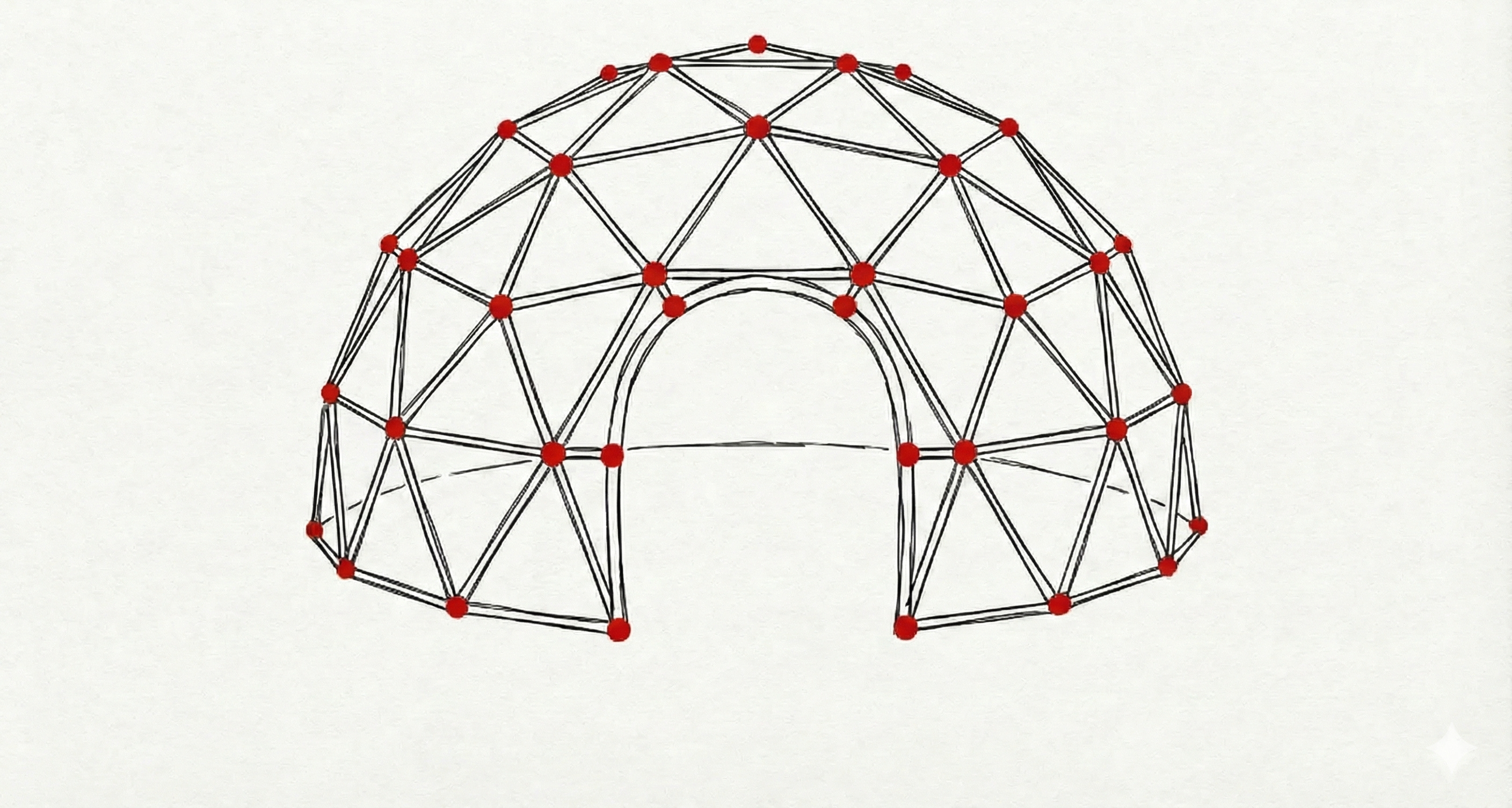
Maturity 2/Phase 2: More key process are trusted with probabilistic frames.
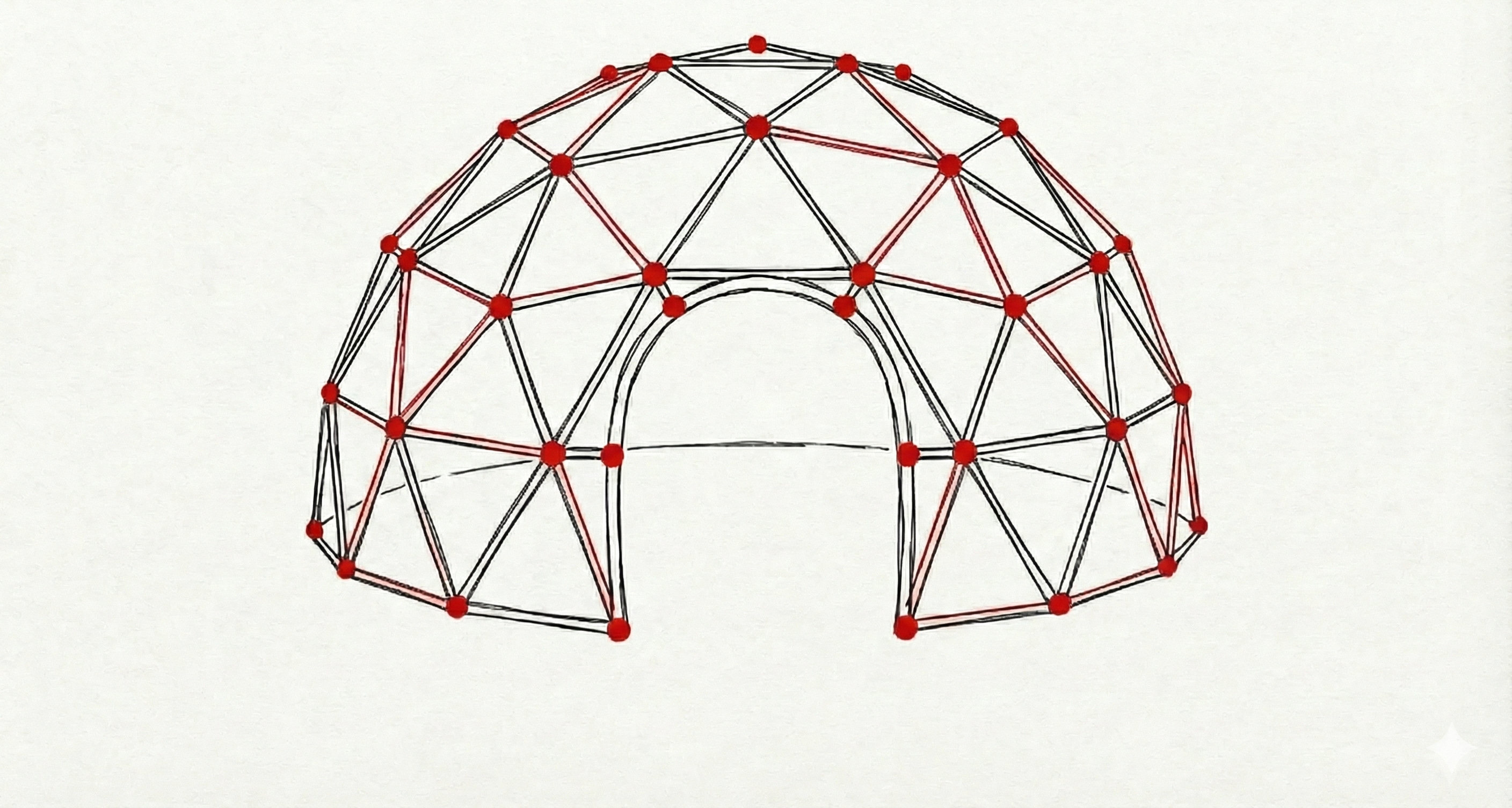
This poses as a strong learning curve from nuts-bolts to supplementing/replacing the deterministic Enterprise scaffolding with an indeterministic form.
Needless to say, the attributes of value is bound to evolve - in fact likely invert.
My research, and experience, identifies 7 key parameters that will influence an Enterprise as it walks on its Agentic Journey. Over time and maturity, the value of these parameters invert—this is The Inversion Matrix.
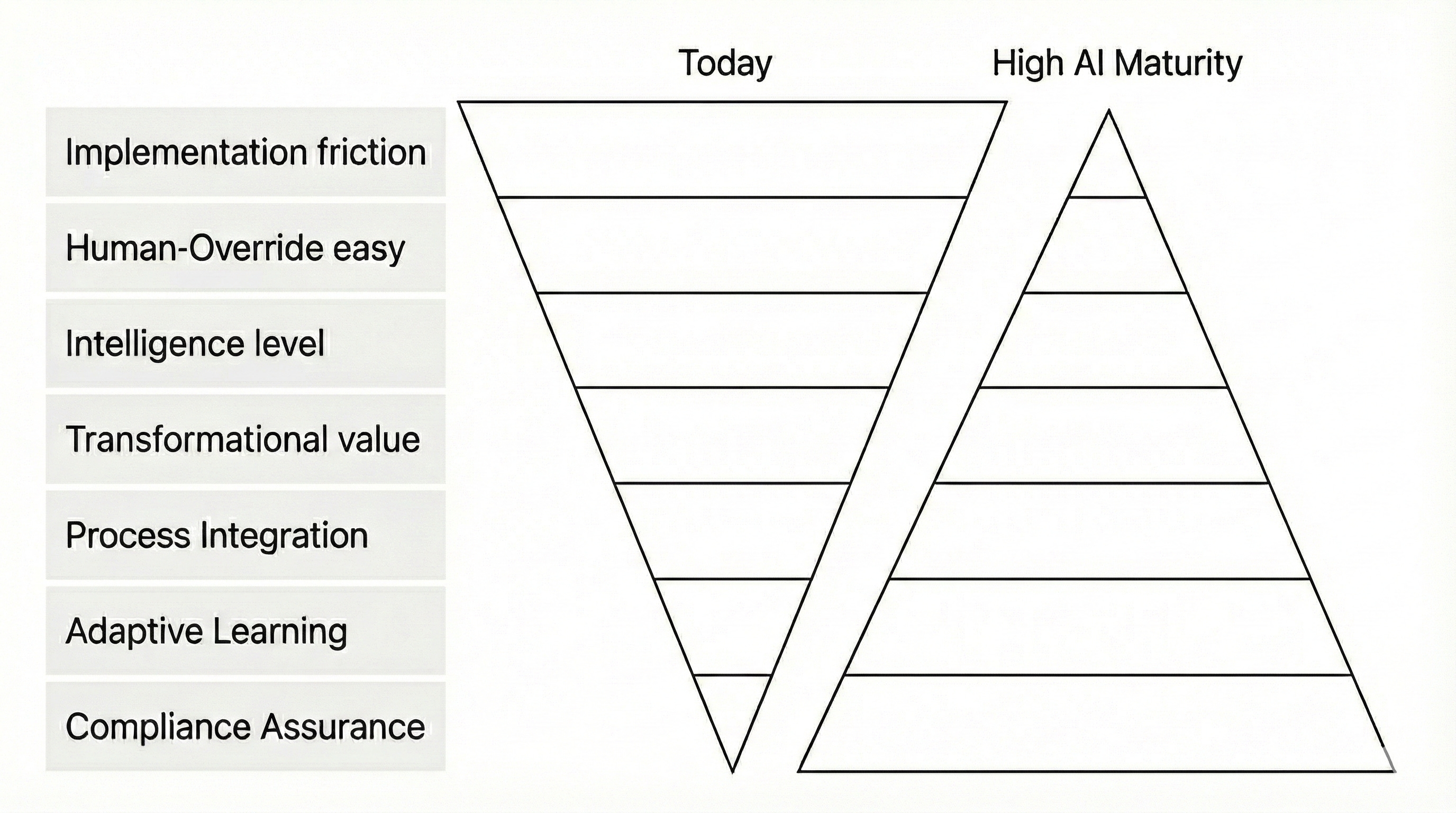
As the “low hanging fruit” of fast-efficiency gets eaten, the ROI equation must flip. The only way to justify the next tranche of spend is Transformational value.
The market will inevitably invert. Integration Friction will cease to be a blocker, and become the accepted cost for Transformational Value.
The shape and size of Enterprise Agentic AI will shift drastically.
Why This Inversion is Inevitable
The market isn’t evolving by choice—it’s being forced by economics. The 27% productivity improvements enterprises currently report come from automating high-volume, low-complexity tasks—a finite inventory. As these efficiency gains saturate (typically within 18-24 months of initial deployment), the marginal cost of AI deployment rises while marginal gains decline.
This is The 18-24 Month ROI Cliff—it’s not a hypothesis, it’s encoded in the economics.
This creates CFO pressure: AI budgets are growing, but the easy wins are exhausted. To maintain ROI momentum and justify the next tranche of spend, enterprises must shift to transformational use cases—those with higher implementation friction but exponentially larger value pools. The shift from efficiency to transformation isn’t visionary; it’s financially mandated.
The integration friction that feels like a blocker today becomes the accepted cost for transformational value tomorrow.
II. Product-Market Fit in Agentic Landscape
For builders, timing is the most important factor today.
You could build the most advanced, ambitious and visionary of the features, and they will likely see very less adoption. On the consumer side, you might have the biggest of the ambition to replace a key inefficient part of the scaffolding with AI, but a successful outcome is less likely till the rest of the machinery (process, people) are ready.
“You’re not competing with other AI products. You’re competing with the deterministic scaffolding you’re asking enterprises to replace.”
It is hence important to identify the axes of Agentic capabilities which you could pull as levers to build successful products that see adoption and usage. The 7 value attributes described above manifest as 5 actionable product dimensions that builders can design for. These dimensions form The Agentic Maturity Ladder.
These five product dimensions will shift with time and learning as both sides (demand & supply) learn and evolve:
Scope: Of work that is trusted with AI
Trust: Level of involvement of humans with AI
Resource: Consumed to produce units of value
Interaction: Ways and modes of interaction with AI
Benchmarking: Units of definition of success
Divided over 3-levels of maturity, Agentic products will evolve with respect to how they are perceived (Tool, Assistant, Orchestration) over these 5 dimensions.
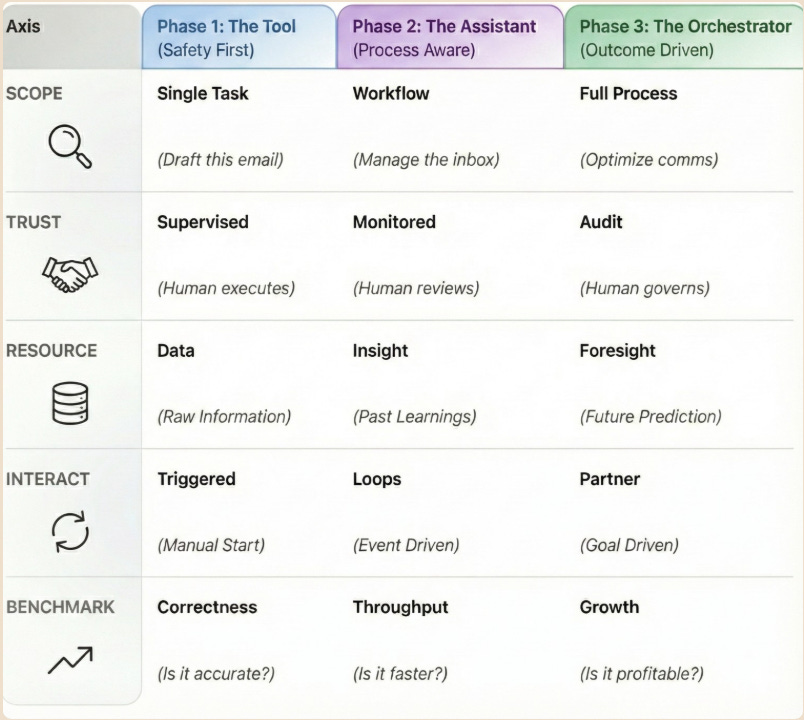
This view helps builders create a map of what problems to tackle, what and how to design, and build with the knowledge of the appetite of the consumers. Deviations from this guidance is likely to either derail your Product, or consume the extra push (Sales/GTM) to derail the ROIs.
III. The Agentic Product Timing Matrix
Where you build determines whether you burn runway or build moats:
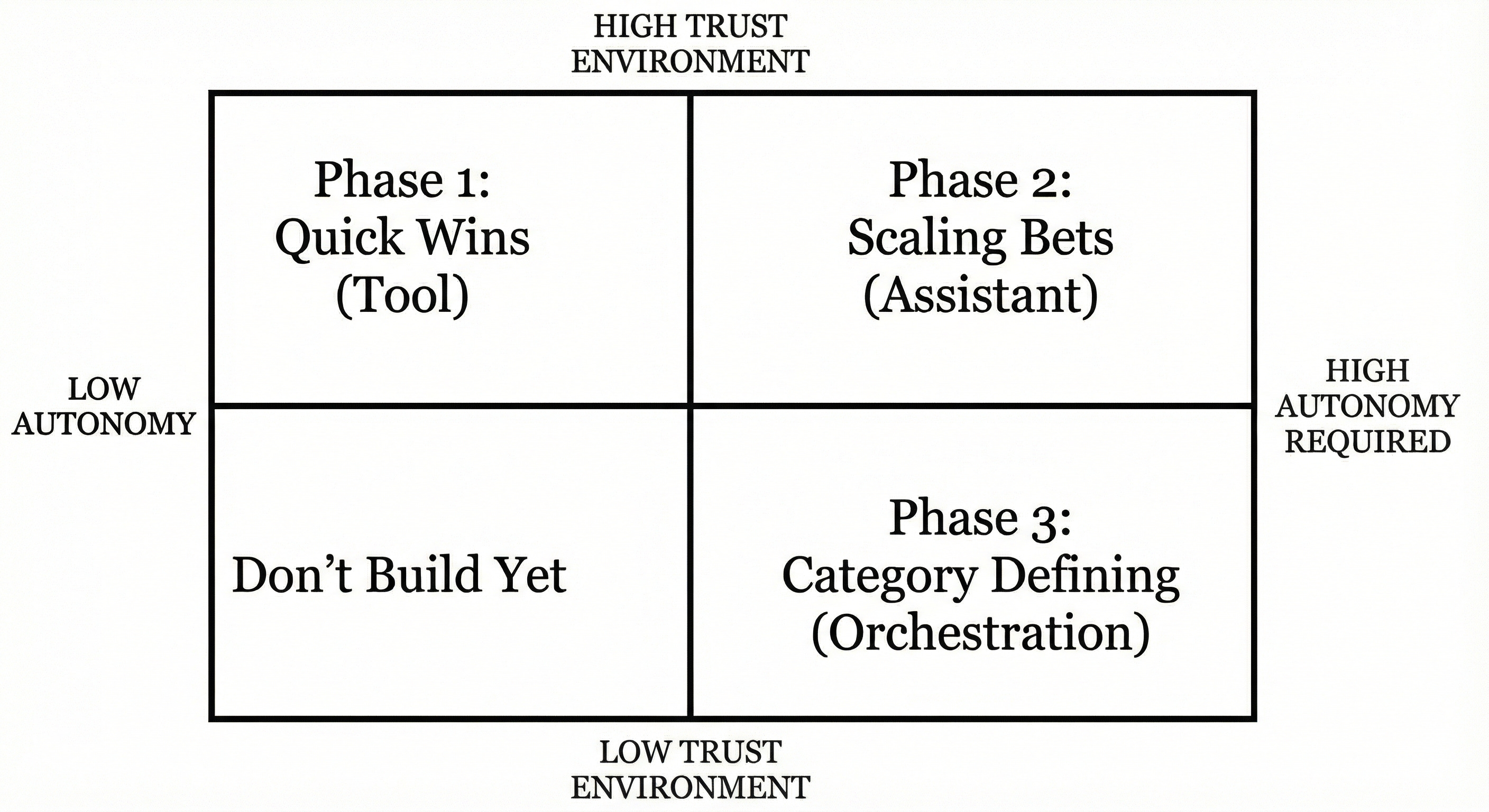
The pattern: Most builders are attempting bottom-right (Phase 3 products) for bottom-left buyers (low trust). The path to adoption moves left→right as trust builds through market maturity.
IV. Where Are You Building? A Diagnostic
Answer these 3 questions to identify your product’s position on the Agentic Maturity Ladder:
1. Scope Question: What percentage of your product’s value proposition relies on the agent making autonomous decisions without human approval?
<10% → You’re building a Tool
10-40% → You’re building an Assistant
40% → You’re building Orchestration
2. Trust Question: If your AI makes a wrong decision, what’s the blast radius?
Reversible, low-cost error → Phase 1 territory
Requires cleanup, medium cost → Phase 2 territory
Irreversible, high-stakes consequence → Phase 3 territory
3. Timing Question: Is your target buyer currently:
Exploring AI pilots and quick wins → You’re 12+ months early for Phase 2-3 products
Scaling successful pilots to core workflows → Window is opening for Phase 2
Reporting AI saturation, looking for next tranche → Prime timing for Phase 2-3
“The enterprises restricting agents to routine tasks today aren’t your laggards—they’re your design partners for Phase 2.”
If you’re building Phase 2-3 products for Phase 1 buyers, you’re facing The Trust-Vision Chasm. Your GTM must become your product moat.
V. For Builders: The Inversion Checklist
If you’re building for Phase 1 (next 12 months):
✓ Design for human-in-the-loop by default, autonomy as opt-in
✓ Compete on integration speed, not capability depth
✓ Build trust through transparency (show your work, not just results)
✓ ROI metric: Time saved per task
✓ Beware: You’re building features, not moats
If you’re building for Phase 2 (12-24 months out):
✓ Build the governance layer today (audit logs, rollback, approval workflows)
✓ Design for progressive trust unlocking (start restricted, expand with usage)
✓ Partner with Phase 1 leaders as design partners—they’re calibrating risk tolerance
✓ ROI metric: Workflow transformation (not just task automation)
✓ Opportunity: You’re building the rails for the inversion
If you’re building for Phase 3 (24+ months out):
✓ Accept that you’re funding R&D today for market readiness tomorrow
✓ Your competition isn’t other AI—it’s organizational change management capacity
✓ Demonstrate the economic inevitability, not just the technical feasibility
✓ ROI metric: Net new capabilities (things humans couldn’t do at scale)
✓ Risk: Burning runway before market inverts; Reward: Category ownership
“Timing isn’t just about when you launch—it’s about which trust layer you’re betting on.”
Conclusion
The paradox resolves when you follow the money. Enterprises are spending $6.5M annually on AI while restricting 43% of agents to routine tasks—not because they’re irrational, but because the current ROI math still works. Quick efficiency wins justify Phase 1 investment. But those low-hanging fruits are finite. Within 18-24 months, the only path to justify the next tranche of spend is transformational value—which requires moving agents to core processes.
The inversion isn’t a hypothesis; it’s an inevitability encoded in the economics. For builders, this creates a timing arbitrage: products positioned for Phase 2-3 will likely see a stall—a waiting period where adoption stagnates—but this patience creates category defensibility when the market inevitably inverts. The strategic choice isn’t whether to build for vision or trust—it’s which layer of the stack you’re betting on, and how much short-term friction you’re willing to absorb for long-term position.
Build too early, and you burn runway educating the market. Build too late, and the orchestration layer is already owned. The window is narrow, but the signal is clear: the enterprises restricting agents to routine tasks today are calibrating their risk tolerance for the bets they’ll make tomorrow. Build the bridge they’ll need when the ROI math forces their hand.